Who needs another accounting, CRM or SaaS system?
Martin Kratky ·
Fair question. There are already hundreds of CRMs, dozens of solid accounting packages, and a new "AI-powered" platform launching every week. Why would anyone build another one?
We asked ourselves the same thing for a long time. The honest answer is that we spent fifteen years being paid to fix the problem this market keeps creating, and eventually it made more sense to fix it at the source.
Good islands, no bridges
The individual tools are good, and that's worth saying up front. There are excellent CRMs and capable accounting systems. Project tools, payroll and helpdesks have all improved enormously over the last decade.
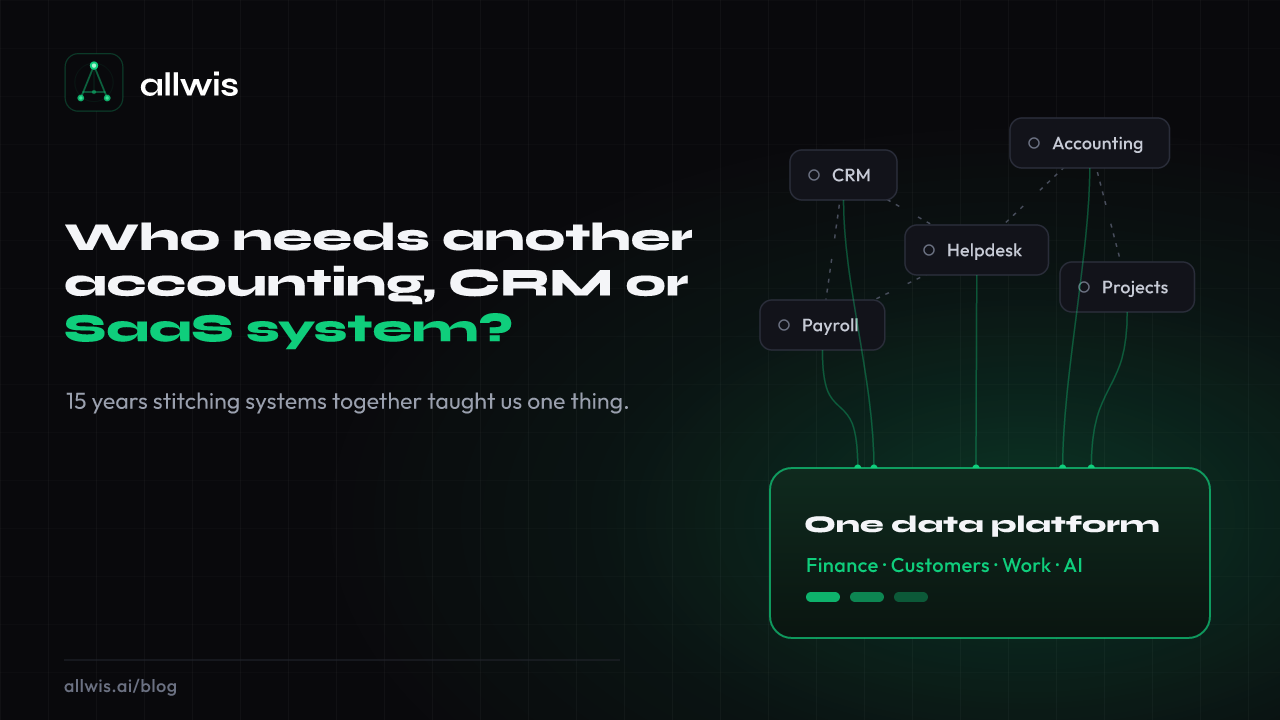
The trouble is that each one is an island. Your customers live in one system, your invoices in another, your timesheets in a third and your payroll in a fourth. Each island has its own login, its own data model and its own idea of what a "customer" is.
Two things follow from that.
1. You pay rent on every island, and the rent keeps going up. Once your data lives in a vendor's system, leaving is painful, and vendors know it. Per-seat pricing creeps upward. Features you relied on move into a higher tier. Integrations you need sit behind an "enterprise" plan. The pricing tends to reflect how hard it is for you to leave more than what the product delivers.
2. You have to build the bridges yourself. None of these systems was designed to work with the others. Someone has to connect them, keep them in sync and reconcile them when they disagree. Usually that's you, a consultant, or a pile of connectors that break quietly at the worst moment.
We know, because we built the bridges
For fifteen years we ran Managility, a consulting firm that specialised in exactly this work: taking a business's scattered systems and making them tell one coherent story.
Projects typically started at five figures and often ended up at six. That wasn't because we were greedy. The work genuinely takes that much effort. You need a central database (a data warehouse), connectors into every source system, and mapping logic to reconcile three different definitions of "customer" and four versions of "revenue". Then you maintain it every time a vendor changes an API or a client adds a new tool.
We were good at it and our clients got real value. Over time, though, one fact became hard to ignore. Most of that budget went on undoing fragmentation that never needed to exist. The businesses weren't paying for insight. They were paying for plumbing.
AI makes the islands worse, not better
Now every legacy SaaS vendor has discovered AI. Every product has a copilot, an assistant or an "intelligent" feature.
Look closely at what that AI can see, though. Your CRM's AI knows about your pipeline and nothing about whether those customers pay on time. Your accounting system's AI knows your cash position and nothing about the deals that will change it next quarter. Your project tool's AI knows how many hours were logged and nothing about whether the job is profitable.
AI is only as good as the context it has, and island software gives it an island's worth of context. The questions a business owner actually asks cross those boundaries:
- Which customers are profitable once you count the time we really spend on them?
- Which deals will turn into cash, and when?
- Where is the margin leaking?
Answering those still means building the data warehouse first. The AI hasn't removed the integration problem. It has made the problem more expensive to ignore.
So we built Allwis
Allwis is what we wished we could have handed our consulting clients: one data platform, with CRM, accounting, payroll, projects, proposals, marketing and helpdesk built on the same foundation from day one.
That changes a few things:
- No stitching. A deal, the proposal that won it, the job that delivers it, the hours logged against it, the invoice that bills it and the payment that settles it all sit in one connected record. There's no warehouse to build because the data was never split up.
- AI that sees the whole business. When the AI scores a deal, checks an invoice or answers a question, it works from finance, customers and delivery together, not one island's slice. That is what "built for AI" actually requires, and it can't be added to fragmented systems afterwards.
- One price, not a rent roll. Replacing a stack of subscriptions with one platform isn't only simpler. It removes the lock-in pressure that drives island pricing in the first place.
More than integrated
Putting everything in one place is the starting point, not the whole story. Two things that were the hardest parts of our consulting work are built into Allwis.
Multi-entity and statutory consolidation. Many growing businesses aren't one company. They're a holding company, a couple of operating entities, maybe an overseas subsidiary. Consolidating them properly means intercompany eliminations, foreign-currency translation, minority interests and equity-accounted investments. Most tools in this market either don't do it or hand it off to an add-on and a spreadsheet. In Allwis every entity runs on the same ledger, so the group view is part of the platform rather than a month-end project.
The specific needs of service businesses. Two kinds of business kept coming back to us with requirements that general-purpose software ignores:
- Accounting and advisory practices. Allwis covers nearly all of practice management: one view across every client that shows what needs attention, jobs and timesheets through to billing, document requests clients answer through their own portal, and proposals. It also covers the new AML/CTF obligations that Australia's reforms now place on accountants, with customer due diligence, a written AML/CTF programme and reporting. That sits alongside the accounting features the practice uses for its own books.
- Software and subscription businesses. Licence and contract handling, ARR calculated from the contracts themselves (with the movement explained as new, expansion, contraction and churn), and revenue recognition that spreads each invoice across the period it is earned in, with the journals posted for you.
These are exactly the areas organisations still manage by hand in spreadsheets, or pay for with expensive custom solutions. We know how much effort that takes, because for years we were the ones building those custom solutions.
Built to be extended, and to earn from
Every business is a little different. In the old world, that difference was where the consulting budget went.
Allwis is designed to be extended simply, so a business can shape the platform to how it actually works without starting a five- or six-figure project. Because everything shares one data foundation, an extension built for one business can work for others.
That's where Cultiver comes in. Cultiver is the marketplace for the Allwis ecosystem, where Allwis add-ons and extensions are listed, bought and paid for. It's also the step the island model never offered. When you build something useful on Allwis, such as a workflow, a module or an industry-specific setup, you can choose to offer it to other businesses on Cultiver and earn from it. Cultiver handles billing, tax and payouts, so selling your know-how doesn't mean building a software company around it.
You get a tailored solution at minimal cost, and if you want to, a way to turn what you've built into revenue.
(Allwis and Cultiver are both operated by Allwis Pty Ltd.)
So, who needs another system?
Probably nobody needs another island. What many businesses do need is fewer of them: one place where the whole business lives, where AI can see all of it, and where the next improvement is an extension rather than an integration project.
We spent fifteen years building bridges between islands. Allwis is our attempt to make the bridges unnecessary.