
The ERP interface in the AI age: from operating to overseeing
Martin Kratky ·
A recent exchange about whether AI will kill SaaS ended on a point everyone agreed with: a business owner shouldn't need to understand CRM, payroll, ledgers or integrations. She should state what she needs, like "pay my contractor" or "am I okay for GST this quarter", and never see a module.
That's right. But it raises the question every ERP vendor now has to answer honestly. If nobody should operate software anymore, what is the interface for?
Our answer: the interface stops being where you operate the system, and becomes where you oversee the business.
What disappears
Most of what an ERP's screens are for is teaching people to operate the system:
- menus organised by module rather than by what you're trying to get done
- data-entry forms that exist because the software couldn't read the invoice
- navigation built around the vendor's org chart ("that's in Payables, not Purchasing")
- reports you run, export and rebuild in a spreadsheet to answer one question
None of that needs to survive. What's left should be shaped by the person using it, not the vendor: the handful of pages they actually rely on, kept where they put them. "Pay my contractor" touches timesheets, a bill, a bank payment and a tax code. That's four modules in the vendor's head and one outcome in yours.
What takes its place: six questions
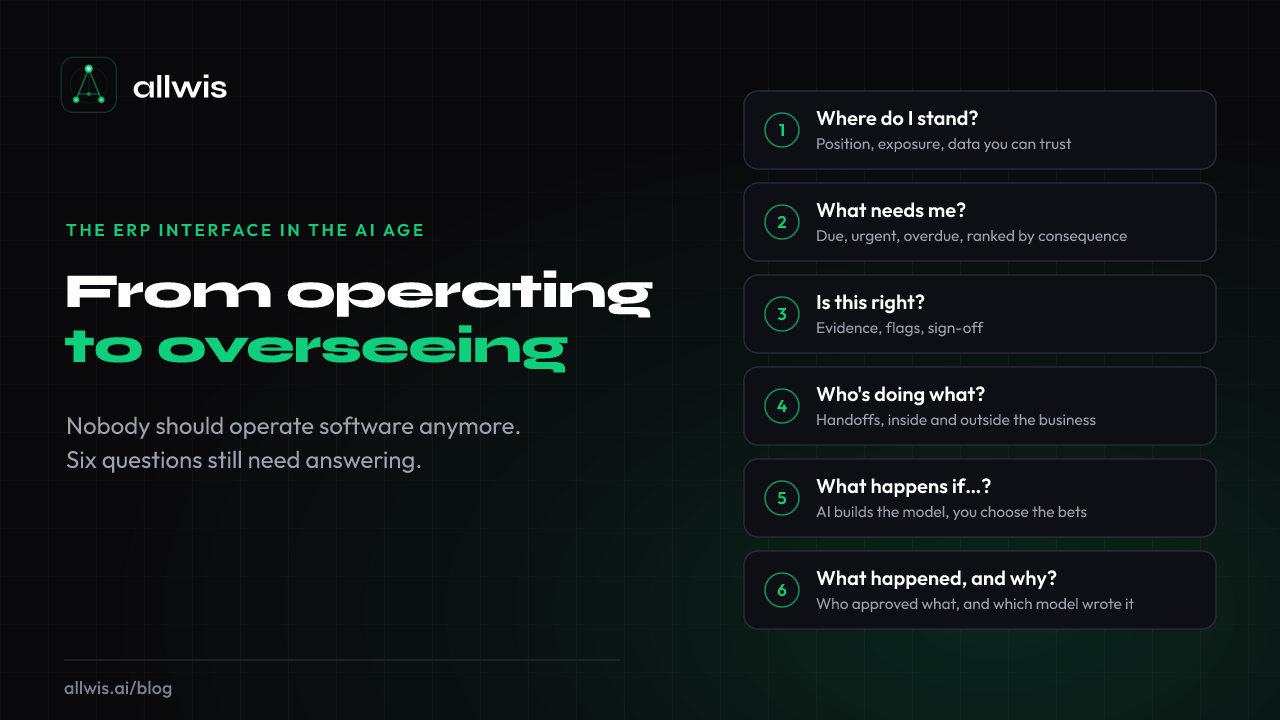
Take the operating away and look at why someone still opens the system. It comes down to six questions:
- Where do I stand?
- What needs me?
- Is this right?
- Who's doing what?
- What happens if…?
- What happened, and why?
Notice what isn't on the list: "ask". Plain language is how you reach all six, not a seventh job. It's the part everyone is building first, and it's the easy part. What matters is what the system owes you once you've asked.
1. Where do I stand?
The state of the business at a glance: cash, what's owed in and out, the tax position, and the exposures that don't show on a balance sheet, like a director's personal liability for tax the company hasn't paid.
Two things make this honest. First, only what's material. Forty tiles on a dashboard means nobody decided what matters. Second, the position is only as good as the data under it. A cash figure built on three weeks of unreconciled bank lines is a guess, and the interface should say so next to the figure, not in a report nobody opens.
2. What needs me?
An agenda, not a set of modules. Everything due, urgent or overdue across the business, in one list, ranked by consequence rather than date.
Consequence has to follow dependencies, because most tasks exist to feed another one. Forty uncategorised bank lines look like routine housekeeping. If they fall inside the period of a tax return due in three days, they are the tax return: it can't be finished until they're done, so they inherit its deadline. The same forty lines from this month can wait. A list sorted by due date misses both of those; so does one that treats every item on its own.
It also includes what other people are waiting on you for: the approval holding up a supplier payment, the question your accountant asked last Tuesday. In most businesses the work that slips isn't hard. It's work nobody knew was theirs.
3. Is this right?
When AI does the work, the person's job is to judge it, and the interface's job is to make that judgment possible.
Every answer carries its evidence. Not "your GST is $4,210", but $4,210 alongside the invoices and bills that make it up, what was excluded and why, and anything that looks unusual. A number you can check in two seconds is worth more than a confident one you can't check at all.
Refuse rather than guess. When two records disagree, like an invoice imported twice with different amounts, the system surfaces the conflict instead of quietly picking one. An AI that resolves ambiguity silently is making accounting decisions nobody authorised.
AI flags; people adjust. An AI audit points at the anomaly and leaves the amount alone. The moment software silently corrects figures, nobody can say whose figures they are.
Make the context impossible to miss. In a group of businesses, the costliest mistake usually isn't a wrong number. It's a right number in the wrong company. Nobody signing off should have to read a small label to know which business they're acting for.
Sign-off goes where accountability is. Not every step needs approval, only the ones where money, filings or commitments leave the business. When a figure on a tax return is wrong, a person answers for it. AI can't sign a return or answer to a regulator. So the question isn't whether a person is involved, it's whether their involvement is meaningful or decorative. Asking someone to approve output they can't evaluate makes them liable for something they never understood.
4. Who's doing what?
Finance work rarely stalls in a calculation. It stalls in a handoff: the client who hasn't sent last quarter's statements, the supplier who needs to fix an invoice, the bookkeeper waiting on the owner, the owner waiting on the accountant.
So the interface has to show who is holding each piece of work, including people outside the business. The conversation belongs next to the record it's about, not in someone's inbox. Asking the accountant "is this right?" should send the question with its evidence attached, not a copied paragraph in an email.
5. What happens if…?
Looking ahead: next quarter's cash, what a new hire costs, what happens if the biggest customer pays late. AI is very good at building the model. The assumptions are the business owner's decision, because they're the owner's bets.
So the AI proposes and the person decides. A forecast that quietly changed because a model thought it knew better is a forecast nobody can defend to a bank.
6. What happened, and why?
The ledger outlives every conversation. Your tax office, your bank, your auditor and your first investor will all read it, and it has to be right on day 400, not just the day it was written.
That means recording who approved what, when, and on what evidence. It also means naming the author: every AI output should record which model produced it, because the model behind today's answer may not be the one behind last quarter's, and an auditor will ask.
Across all six: say what you don't know
"Nothing to review" and "we didn't look" must never look the same. If a scan was capped or a source couldn't be read, the interface says so. In finance, silence reads as an all-clear.
And the business should own the intelligence. Which AI model runs your finance is your decision, including running one on your own hardware if your data can't leave it. Intelligence you rent with no choice of provider is just a new kind of lock-in.
How we build this at Allwis
We've built Allwis around these questions. What that looks like in the product today, with a short video where one shows it working. You can reach all of it by asking the Concierge in plain language; it plans the steps and shows them to you before it runs anything. Watch: Allwis Concierge — ask your books anything (0:27).
Where do I stand? Allwis checks its own data and lists what would make a figure wrong, such as invoices not assigned to a business in the group or lines missing a tax rate. For Australian companies, it shows directors how much unpaid withholding, GST and super could become their personal liability, and which amounts can still be dealt with before that happens. Watch: Who owes you, and why — from the aging report to the customer (1:10).
What needs me? Tasks can be assigned to a person or to a team, and team work follows the team as people join and leave. Accountants and bookkeepers see every client they work for on one page, busiest first, with what's waiting in each: unreconciled transactions, invoices awaiting approval and overdue receivables. Anyone can pin the pages they return to most, so their own work sits at the top of the sidebar rather than inside a menu. Watch: The numbers you can still change (1:28).
Is this right? When Allwis audits an incoming bill or a sales commission, it writes its concerns next to the record and never changes the amount. A person approves the bill, and a person approves the commission before it's paid. Re-import a transaction history where one invoice has changed price, and Allwis reports the conflict rather than picking a winner. It never silently posts a second copy. In a group, each business has its own colour across the app, so which company you're working in is obvious at a glance, not a word in a label. Watch: AI bill audit — catch errors before you pay (0:20); a colour for each company in a group (1:48).
Who's doing what? A business can send its client a checklist of documents to provide. The client uploads them through their portal, reminders go out on a schedule, and the request is complete only when a person has accepted every required item. An answer from the Concierge, Allwis's built-in assistant, can be sent to the business's accountant to confirm, with the question and answer attached. Watch: Bookkeeping review, accounting answers and your accountant's sign-off (1:27); Comment on any report figure (0:25).
What happens if…? In planning, the AI suggests changes to a budget or forecast, and nothing changes until a person accepts them. Scenarios are laid over the plan as assumptions, so the plan itself stays as it was until someone deliberately adopts one. Watch: Budgets, forecasts and what-if comparisons (0:34).
What happened, and why? Deal scores, commission audits, email summaries and ticket triage all record which provider and model produced them, and the record keeps that label. Our review of backdated transactions asks whether an entry crossed a period that was already closed or already lodged at the time it was written, not as things stand today. An honest January entry for December is ordinary bookkeeping. The same entry made after December's return was lodged is worth checking. Watch: AI deal scoring — every score explained (0:23).
Saying what we don't know. Where a review or scan is capped, the page says so. "Nothing found" is only shown when the whole scan finished.
Owning the intelligence. Each workspace picks its own AI provider, and can route different tasks to different models. Allwis can also run on a model hosted on your own hardware. If your workspace is set to self-hosted AI only, it never falls back to a cloud model, even when your own machine is offline. We'd rather a feature stops working than break that promise.
The skill that remains
For thirty years, ERP skill meant knowing where things are in the system. That skill is going away, and good riddance.
What replaces it is oversight: knowing where the business stands, what needs attention, whether the work is right, who is holding what, and what's coming. The best AI-age ERP won't be the one that asks you the fewest questions. It will be the one that answers these six clearly, shows its working, and remembers forever what you decided.
AI removes software-building, and software-operating, as a prerequisite. It doesn't remove accountability. The interface that wins will make that accountability easy to carry.