Software that works with you
Martin Kratky ·
For decades, business software has been something you operate. You open it, find the right screen, type the numbers in and press the button. The software waits. It does exactly what it was built to do, and nothing else, until the next release.
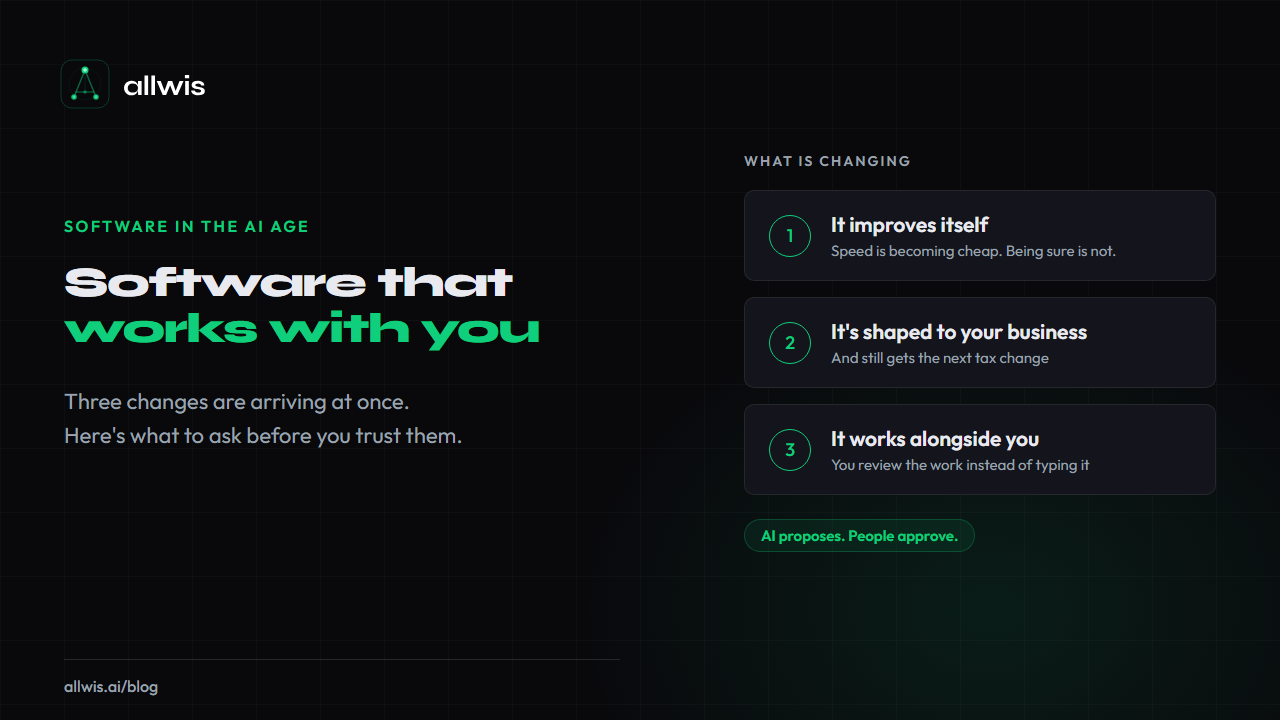
That model is ending. Three changes are arriving at once: software that improves itself, software that fits each business closely, and software that does part of the work alongside you rather than waiting to be told. Each one is real today in an early form. Together they change what a small or mid-size business should expect from the tools it runs on, and what it should demand before it trusts them.
Software that improves itself
AI can now write a working change to a large codebase in minutes. Fixing a reported bug, adding a missing field or tidying a confusing screen used to wait weeks for a slot in someone's sprint. Increasingly, it doesn't have to.
The interesting consequence is not speed. It is that writing code stops being the hard part. The hard part becomes knowing whether a change is right. A change that looks plausible and is subtly wrong is worse than no change at all, especially in software that keeps your books. An invoice that double-counts GST still balances. A report that quietly skips a few rows still renders.
So the software vendors worth trusting over the next few years will not be the ones that change fastest. They will be the ones that can prove, every time, that a change did what it claimed and broke nothing else. Speed is becoming cheap. Being sure is not.
Software shaped to your business
Every business has the way it actually works, and the way its software makes it work. The gap between the two is filled with spreadsheets, workarounds and a person who knows which button not to press.
Until now there were two options. Buy off-the-shelf software and bend your business to it, or pay for custom software and live with the cost of maintaining it. Custom builds age badly: every upgrade to the underlying product risks breaking the part that was made just for you.
AI changes the economics. Fitting a product to one business no longer takes a project and a consultant, so the request "can it do this our way?" can get a yes far more often. But it raises a harder question for every vendor: how do you let thousands of businesses each have it their way, without ending up with thousands of slightly different products that can no longer be kept safe and up to date?
The answer matters more to you than to the vendor. Ask any provider how your tailored version gets the next security fix, the next tax change, the next improvement. If the honest answer is "carefully, by hand", that tailoring has a cost that just hasn't been billed yet.
From operating software to working with it
The biggest change is the quietest. Software is starting to do part of the job, not just record it. It reads the supplier's bill and checks it against the purchase order. It notices the deal that has gone quiet. It drafts the reminder for the invoice that is 30 days overdue. You stop driving every step and start reviewing the work.
That sounds like a small shift in interface. It is a large shift in responsibility. When software acts, three questions decide whether you can trust it:
- What did it base this on? A suggestion you can check against its evidence in a few seconds is useful. One you have to take on faith is a liability.
- Who decided? For anything that moves money, files a return or reaches a customer, a person should confirm it. Our short form for this is: AI proposes, people approve.
- Which AI did this? Models change every few months. A record of which model produced which output is what lets you explain a decision a year later.
The screens don't disappear. They become the place where you review, correct and approve, rather than the place where you type.
What doesn't change
Faster, more flexible, more capable software is still only as good as the records underneath it. A debit still needs its credit. A tax return still has to agree with the ledger. Payroll still has to be right on the day, not on average.
That is why we think the durable value in business software is moving down, not up. Screens will be generated, rearranged and personalised. What has to stay fixed is the part that makes the numbers trustworthy: the accounting rules, who can see what, and a complete record of who changed what and when. Those are the things you should never have to wonder about, however quickly everything above them changes.
And your data stays yours. More AI should mean more choice over where it runs, not less. Some businesses will want the best cloud model available. Others will want a model on their own hardware and nothing leaving the building. Both are reasonable, and the software should respect the choice rather than make it for you.
Choosing software now
If you are picking the system your business will run on for the next five years, the feature list matters less than it used to. Features will arrive faster than ever, from everyone. Ask instead:
- When the AI suggests something, can I see why? Look for the evidence beside the suggestion, not a confidence score on its own.
- What can it do without me? Know exactly which actions need a person's approval, and check that the list covers money, tax and customers.
- Can I tell which AI produced an output, and choose where it runs? Including on your own hardware, if that matters to you.
- If you change it for me, how does my version stay current? Tailoring that falls behind on the next tax change is not a feature.
- How do you know a change is right before it reaches me? The answer should be specific. "We test it" is not an answer.
At Allwis we are building for this shift from the start, as one platform covering CRM, accounting, payroll, jobs, marketing and helpdesk. The principle we keep returning to is simple: software should do more of the work, and you should always be able to see what it did, why, and who approved it. The software is changing quickly. That principle won't.